

How to choose a controller for a high speed servo motor?
Aug 22, 2025
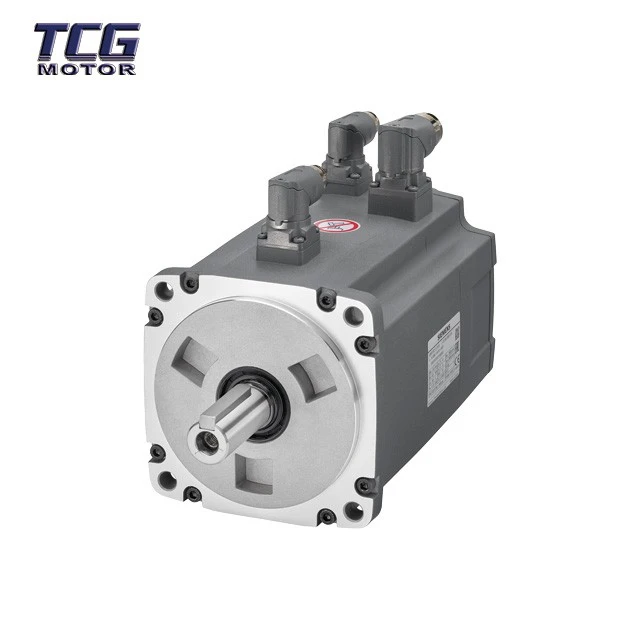
As a supplier of High Speed Servo Motors, I understand the importance of choosing the right controller for these high - performance motors. High - speed servo motors, such as our High Speed Servo Motor, are designed to operate at extremely high rotational speeds while maintaining precise control over position, velocity, and torque. The controller plays a crucial role in ensuring that the motor performs optimally and meets the specific requirements of the application.

Understanding the Basics of High - Speed Servo Motor Controllers
A servo motor controller is an electronic device that manages the operation of a servo motor. It receives input signals from a control system, such as a programmable logic controller (PLC) or a motion controller, and then sends appropriate electrical signals to the servo motor to achieve the desired motion. For high - speed servo motors, the controller must be able to handle high - frequency signals and rapid changes in speed and position.
There are several types of servo motor controllers available in the market, including analog controllers, digital controllers, and hybrid controllers. Analog controllers are relatively simple and cost - effective, but they may lack the precision and flexibility required for high - speed applications. Digital controllers, on the other hand, offer greater precision, flexibility, and programmability. They can handle complex control algorithms and communicate with other devices using various communication protocols. Hybrid controllers combine the advantages of both analog and digital controllers.
Key Factors to Consider When Choosing a Controller
1. Compatibility with the Motor
The first and most important factor to consider when choosing a controller is its compatibility with the high - speed servo motor. The controller must be able to provide the correct voltage, current, and frequency to the motor. It should also support the motor's feedback device, such as an encoder or a resolver. For example, our 7.5KW 380V AC Servo Motor requires a controller that can handle its specific power requirements and communicate effectively with its encoder.
2. Control Performance
The control performance of the controller is another crucial factor. High - speed servo motors often require precise control over position, velocity, and torque. The controller should be able to provide fast response times, high bandwidth, and low steady - state error. It should also be able to handle disturbances and variations in the load without sacrificing performance. Look for controllers that offer advanced control algorithms, such as proportional - integral - derivative (PID) control, feed - forward control, and adaptive control.
3. Communication and Interface
In modern industrial applications, the ability of the controller to communicate with other devices is essential. The controller should support standard communication protocols, such as Ethernet, Modbus, CANopen, and Profibus. This allows it to be integrated into a larger control system and communicate with other devices, such as PLCs, HMIs, and sensors. Additionally, the controller should have user - friendly interfaces, such as a touchscreen or a PC - based software interface, for easy configuration and monitoring.
4. Safety Features
Safety is always a top priority in industrial applications. The controller should have built - in safety features to protect the motor and the operator. These features may include over - current protection, over - voltage protection, under - voltage protection, over - temperature protection, and short - circuit protection. Some controllers also offer functional safety features, such as safe torque off (STO), which can be used to quickly stop the motor in case of an emergency.
5. Cost
Cost is also an important consideration when choosing a controller. While it is important to invest in a high - quality controller that meets your requirements, you also need to consider your budget. Compare the prices of different controllers and evaluate their features and performance to find the best value for your money. Keep in mind that the cheapest controller may not always be the best option, as it may lack the necessary features and performance for your application.
Application - Specific Considerations
1. CNC Lathe Machine Applications
In CNC lathe machine applications, the controller must be able to provide precise control over the position and speed of the spindle and the axes. Our CNC Lathe Machine Servo Motor requires a controller that can handle high - speed machining operations and provide accurate contouring. Look for controllers that offer high - speed interpolation, tool compensation, and synchronization features.
2. Robotics Applications
In robotics applications, the controller must be able to coordinate the movement of multiple joints and axes. It should be able to handle complex motion profiles and provide smooth and precise movement. The controller should also support kinematic calculations and inverse kinematic algorithms to convert the desired end - effector position into joint angles. Additionally, it should be able to communicate with other components of the robot, such as sensors and grippers.
3. Packaging and Printing Applications
In packaging and printing applications, the controller must be able to provide high - speed and accurate motion control. It should be able to handle rapid changes in speed and position and maintain precise registration. Look for controllers that offer high - speed servo control, web tension control, and color registration control.
Testing and Evaluation
Once you have selected a few potential controllers, it is recommended to conduct testing and evaluation. This can be done by setting up a test bench with the high - speed servo motor and the controller. Run a series of tests to evaluate the controller's performance, including its response time, accuracy, stability, and communication capabilities. Compare the results of the tests with your requirements and choose the controller that best meets your needs.
Conclusion
Choosing the right controller for a high - speed servo motor is a critical decision that can significantly impact the performance and reliability of your application. By considering factors such as compatibility, control performance, communication and interface, safety features, and cost, you can select a controller that meets your specific requirements. Additionally, by taking into account application - specific considerations and conducting thorough testing and evaluation, you can ensure that the controller will work effectively in your application.
If you are in the process of choosing a controller for your high - speed servo motor and need further assistance, we are here to help. As a leading supplier of high - speed servo motors, we have extensive experience and expertise in this field. Our team of experts can provide you with professional advice and guidance to help you make the right choice. Contact us today to start a discussion about your specific needs and explore the best solutions for your application.
References
- Dorf, R. C., & Bishop, R. H. (2017). Modern Control Systems. Pearson.
- Krause, P. C., Wasynczuk, O., & Sudhoff, S. D. (2013). Analysis of Electric Machinery and Drive Systems. Wiley.
- Mohan, N., Undeland, T. M., & Robbins, W. P. (2012). Power Electronics: Converters, Applications, and Design. Wiley.