

What is the deceleration time of a Liner Conveyor Motor?
Nov 25, 2025
Hey there! As a supplier of Liner Conveyor Motors, I often get asked about the deceleration time of these motors. It's a crucial aspect that impacts the efficiency and safety of conveyor systems. So, let's dive right in and explore what the deceleration time of a Liner Conveyor Motor is all about.
First off, what exactly is deceleration time? In simple terms, it's the time it takes for a motor to slow down from its operating speed to a complete stop. This might seem like a minor detail, but it can have a big impact on how well a conveyor system works. For example, if the deceleration time is too long, it can cause delays in the production line. On the other hand, if it's too short, it can lead to excessive wear and tear on the motor and other components, and even cause damage to the goods being transported.
There are several factors that can affect the deceleration time of a Liner Conveyor Motor. One of the most important is the type of motor. We offer different types of conveyor motors, such as the AC Series Conveyor Motor, V-belt Conveyor Motor, and DC Series Conveyor Motor. Each type has its own characteristics that can influence the deceleration time.

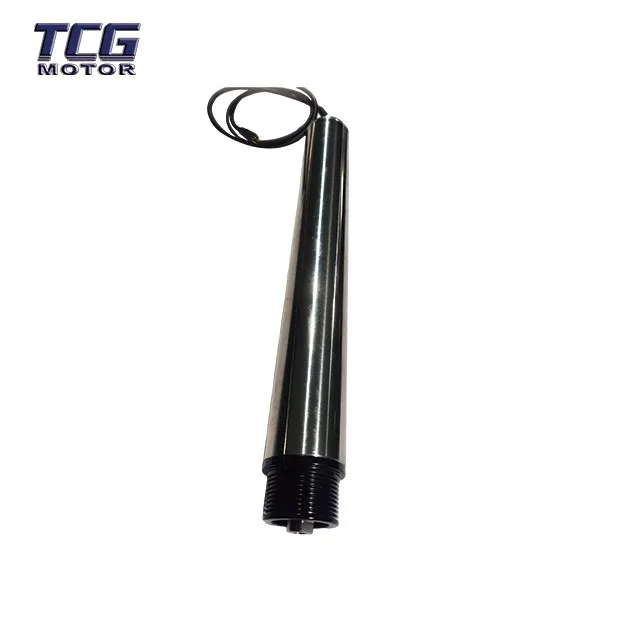
AC motors are widely used in conveyor systems because they're reliable and efficient. They usually have a relatively smooth deceleration process. The deceleration time of an AC motor can be adjusted by changing the frequency of the power supply. By reducing the frequency gradually, the motor slows down at a controlled rate. However, the deceleration time also depends on the load on the conveyor. If the conveyor is carrying a heavy load, it will take longer for the motor to stop.
V-belt conveyor motors are known for their flexibility and ease of installation. They transfer power through a V-belt, which can affect the deceleration time. The tension of the V-belt plays a significant role. If the belt is too loose, it can cause slippage during deceleration, which may increase the deceleration time. On the other hand, if it's too tight, it can put extra stress on the motor and other components.
DC motors offer precise speed control, which means the deceleration time can be more accurately adjusted. They're often used in applications where precise positioning is required. The deceleration time of a DC motor can be controlled by adjusting the voltage applied to the motor. By reducing the voltage gradually, the motor slows down smoothly.
Another factor that affects the deceleration time is the braking system. Some conveyor motors come with built-in braking systems, while others rely on external brakes. Brakes can significantly reduce the deceleration time. There are different types of brakes, such as electromagnetic brakes and mechanical brakes. Electromagnetic brakes are fast-acting and can stop the motor quickly. They work by using an electromagnetic field to create friction and slow down the motor. Mechanical brakes, on the other hand, use physical contact to stop the motor. They're often more reliable in high-temperature environments.
The load on the conveyor also has a major impact on the deceleration time. A heavier load requires more energy to stop. If the conveyor is carrying a large number of heavy items, the motor will have to work harder to slow down. This means the deceleration time will be longer compared to a lightly loaded conveyor. The distribution of the load is also important. If the load is unevenly distributed, it can cause the conveyor to become unbalanced, which can further affect the deceleration time.
The inertia of the conveyor system is another key factor. Inertia is the tendency of an object to resist changes in its motion. A conveyor system with a large inertia will take longer to stop. This includes the mass of the conveyor belt, the rollers, and the load. If the conveyor is long or has a lot of moving parts, it will have a higher inertia, which means a longer deceleration time.
So, how do you determine the appropriate deceleration time for your conveyor system? Well, it depends on your specific application. If you're running a high-speed production line, you might need a shorter deceleration time to keep the production flowing smoothly. However, if you're transporting delicate items, a longer deceleration time might be necessary to prevent damage.
You can calculate the approximate deceleration time using some basic formulas. The deceleration time (t) can be calculated using the formula t = (ω1 - ω2) / α, where ω1 is the initial angular velocity, ω2 is the final angular velocity (usually 0 for a complete stop), and α is the angular deceleration. However, this is a simplified formula, and in real-world applications, there are many other factors to consider.
In some cases, it might be a good idea to consult with an expert. As a Liner Conveyor Motor supplier, we have a team of experienced engineers who can help you determine the optimal deceleration time for your conveyor system. We can take into account all the factors mentioned above and provide you with a customized solution.
If you're in the market for a Liner Conveyor Motor and want to discuss the deceleration time and other aspects of your conveyor system, don't hesitate to reach out. We're here to help you find the best motor for your needs and ensure that your conveyor system operates efficiently and safely. Whether you're looking for an AC Series Conveyor Motor, V-belt Conveyor Motor, or DC Series Conveyor Motor, we've got you covered.
References
- "Conveyor Systems Handbook"
- "Motor Control and Drives"